The check that was never there
I withdrew a claim because I thought a benchmark already handled it. Then I read the paper's appendix instead of its prose, and found the withdrawal was the mistake. CounterFact has no possession check — and a model's own numbers say so.
- Written
- , 7 min read
- Written by
- Saif Ul Islam
- Topics
- Lab notes, Knowledge editing, edit-slice, Method
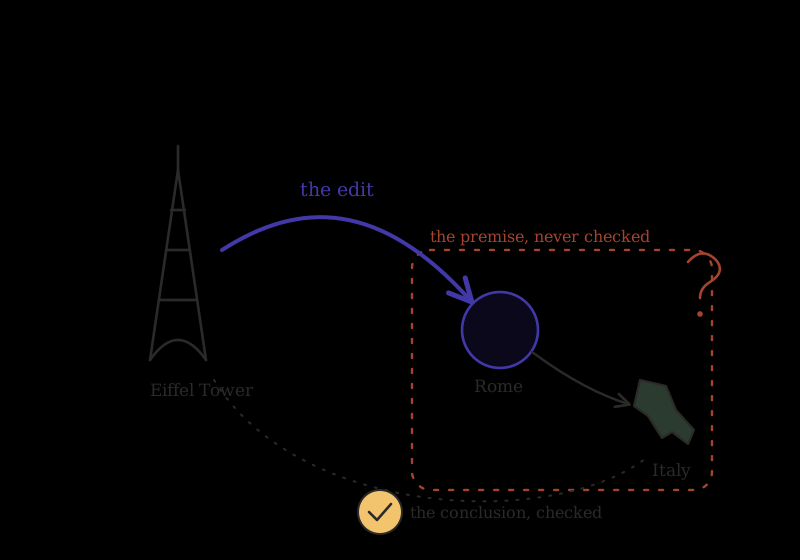
This is a correction to something I published four days ago. The short version: I withdrew a claim I should have kept.
The claim was that knowledge-editing benchmarks measure propagation into knowledge they never verified was there. Edit a fact, check whether the change ripples outward correctly — but if the model never held the fact you edited, a "failed ripple" is an artifact of ignorance rather than a property of the editor.
I searched, found that CounterFact appeared to handle this, and withdrew the claim. That was wrong, and I want to lay out both the evidence and how I got it backwards, because the second part is the more useful half.
What made me withdraw it
CounterFact opens its dataset section by citing exactly this concern:
Hase et al. (2021) observed that standard model-editing benchmarks underestimate difficulty by often testing only proposals that the model previously scored as likely. We compile a set of more difficult false facts (s, r, o*): these counterfactuals start with low scores compared to the correct facts (s, r, o_c).
Read at speed, that is a filter. The authors are aware of the problem, they say so, and they say they compiled the set to avoid it. I concluded the check existed and was merely weak, wrote that up, and moved on.
What the appendix actually says
The construction appendix describes how records were built:
Each record in CounterFact is derived from a corresponding entry in PARAREL … Solely using the PARAREL entry, we derive two elements … o* is drawn from a weighted sample of all PARAREL tuples with the predicate (r, ·).
The counterfactual target is obtained by sampling another object of the same relation — a different city for a city-location prompt. Specificity prompts come from a Wikidata SPARQL query. No model is consulted at any point in construction.
So the sentence in §3.3 is a claim about what that sampling is expected to yield, not a step that was performed with a model. The aspiration is real; the mechanism is sampling. Those are different things, and the difference is the whole argument.
The paper's own numbers agree
This does not rest on my reading of one appendix. Table 4 reports baselines for the
unedited model, and the Efficacy Score column is the fraction of records where
P(false target) > P(true fact).
For unedited GPT-2-XL, the benchmark's own primary model: ES = 22.2.
Twenty-two percent of CounterFact records already favour the false answer before anything is edited. If records had been selected so the model prefers the true fact, that number would be near zero.
Turn it around: GPT-2-XL holds the true fact in 77.8% of records. Which, for what it is worth, is close to the 75% I measured on GPT-2-medium with the same two-way test — exactly what you would expect if no model-specific selection ever happened.
So how bad is it, really?
P(true) > P(false) is a forced choice between two options. It asks whether the
model prefers the real answer to one specific fabricated alternative, which is a
much easier question than whether it holds the fact.
A harder test: does the true answer rank first among 50 type-matched candidates, and does it rank higher with the real subject present than with the subject replaced by a placeholder? The second condition matters — without it, a model that has simply learned "mother-tongue prompts end in a language" scores well on the template alone.
Measured that way, over 165 items per model:
| model | params | possession | template alone |
|---|---|---|---|
| GPT-J | 6B | 56% | 5% |
| Llama-3.1-8B | 8B | 74% | 4% |
| Llama-3.1-70B | 70B | 79% | 4% |
| Llama-3.1-405B | 405B | 85% | 5% |
Monotonic, decelerating, and not saturated at 405B. Fifteen percent of a curated factual benchmark is still not held by the largest model I could reach.
The shortfall on GPT-J is 44% — twice what the benchmark's own two-way number would suggest.
Scale buys the hard relations and leaves the easy ones alone. Native language sits at 80% on a 6B model and flat at 93% above it. The movement is all in the strugglers: original broadcaster 13% → 87%, location of formation 40% → 93%, place of birth 13% → 53%.
That last one deserves a pause. Place of birth tops out at 53% even at 405B, and GPT-J holds 13%. It is among the relations with the richest surrounding context — burial place, citizenship, family — so it is exactly where you would want to look for knock-on effects, and it is the relation every model holds worst.
This is not a criticism of the benchmark
CounterFact was built to make insertion hard, and it does that. Sampling a plausible-but-wrong object of the same relation is a sound way to get difficult targets. Possession of the fact being displaced is a different question, and it was simply never the one being asked.
The problem is downstream. The fixed 21,919 records are now run against GPT-J, Llama, Qwen, Mistral and everything since, and nothing in the standard pipeline asks whether the model under test holds the facts being overwritten.
The fix is cheap: report possession alongside efficacy, measured on your model.
How I got it wrong
Two separate literature passes and neither caught this, because both were searching for competing work rather than re-reading the primary source. I had the ROME paper open in a directory on my own machine the entire time. The appendix was three pages from the sentence I misread.
The narrow lesson: when a claim turns on what a paper did, read its methods appendix before concluding from its prose. Aspiration and mechanism live in different sections and only one of them is binding.
Honest limits
Levels depend on the candidate count. Fifty candidates is harder than ten; more would be harder still. Ordering across models is robust, absolute levels are not, and the config is recorded beside every number for that reason.
Scoring is teacher-forced. That measures whether knowledge is present, not whether the model would spontaneously produce it. On identical items: two-way 75%, constrained 61%, free generation 12% — and the last is depressed mostly by ambiguous prompt templates, not ignorance. Constrained teacher-forcing is the right instrument for possession; free generation bounds it from below.
Prompt sensitivity is not my finding. That models are brittle to phrasing, and that probing can measure wording rather than knowledge, is well established in the factual-probing literature. What is new here is locating it inside an editing benchmark and pricing it.
Rigid relations only for the scale curve — 11 of CounterFact's 34, chosen because the wider project needed time-stable facts. Whether mutable relations behave the same is unmeasured.
I have not run the constrained measure on GPT-2-XL. The benchmark's own model is characterised here by its reported ES alone. Placing it on the same axis as the rest would be worth doing.
The tool is edit-slice. It takes an arbitrary edit set, reports what fraction the model holds, and reports coverage — because a held-rate computed over a silently biased subset is worse than no held-rate. I know that because an early version did exactly that, and inflated its own number by forty points.